Our work
Payroll and tax
Nominal
Payroll, tax and books, with an assistant that knows when to stay quiet
The demo is a recreation of the system, with made-up data: the original belongs to the client and is not published. No sign-up needed.
The context
A fourteen-employee company with an outside accountant has all the numbers —they're in the payroll run, in the bank, in the receipts— and can't consult them. Every question from the owner, «what does it cost me to hire one more?», «why did this go up?», takes two days and a phone call. And the answer everyone carries in their head is always the salary, which is off by forty percent.
What the system does
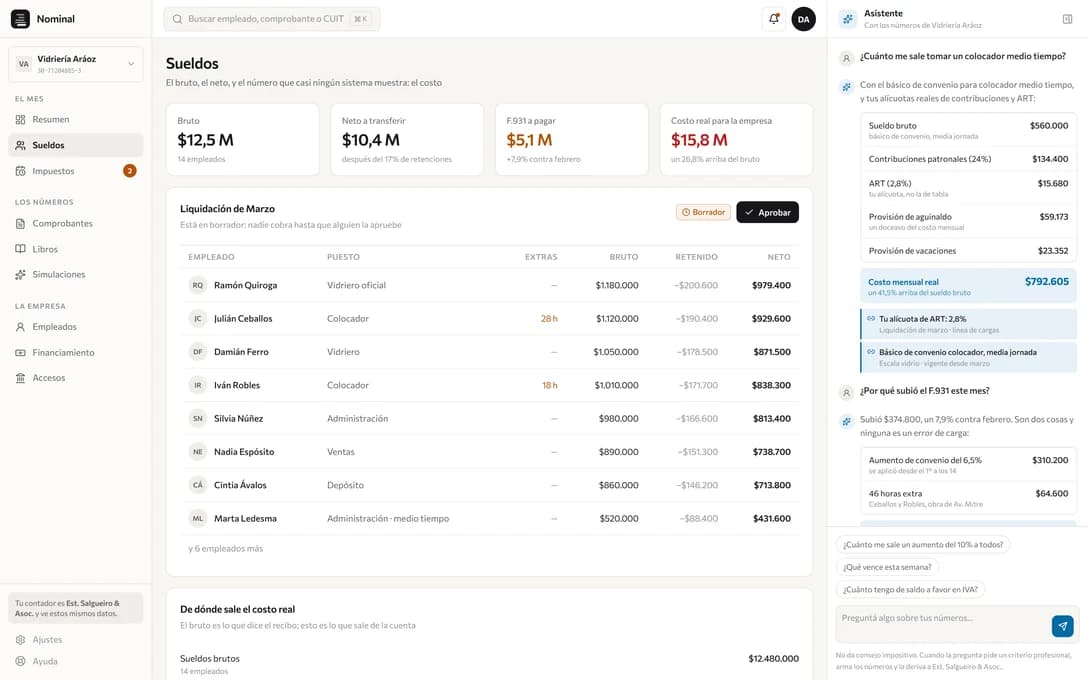
- The assistant lives in a third column, next to the content and not on another screen: the question comes up while you're looking at the payroll run, not at some other time
- It answers with this company's numbers and cites the row each figure came from —this payroll run, this timesheet, this bargaining scale— and the citation opens
- Any answer that is money shows the arithmetic open: salary, contributions, insurance and the two accruals. It's what explains why hiring someone costs 41% more than their salary
- And sometimes it doesn't answer: when the question calls for professional judgment it builds both scenarios, says why the numbers aren't enough, and routes it to the accountant with everything attached
- It knows who's asking. Admin prepares the payroll and can't ask it what each person earns: the permission is about what it can say, not about which screens are visible
- The deadline calendar says who does each thing, which is where almost every penalty at a small company with an outside firm comes from
- In the general ledger every entry says whether it came in on its own or someone typed it: the three entered by hand are the three that need judgment
- And in financing, the first line warns there's a commission involved and the offers are sorted by total cost, not by installment