Our work
Sports clubs
ScoreLogics
The ERP of a lower-division club, where the data is who can play
The demo is a recreation of the system, with made-up data: the original belongs to the client and is not published. No sign-up needed.
The context
A second-division club runs on three spreadsheets that don't talk to each other: the coaching staff's with the squad, the doctor's with the injuries and admin's with the contracts. None of the three answers the only question that matters on Thursday afternoon —who can play on Sunday— because the answer is spread across all three. And the two most expensive ways to lose a player in the lower divisions don't happen on the pitch: you lose him to a yellow card nobody counted and to a contract nobody looked at.
What the system does
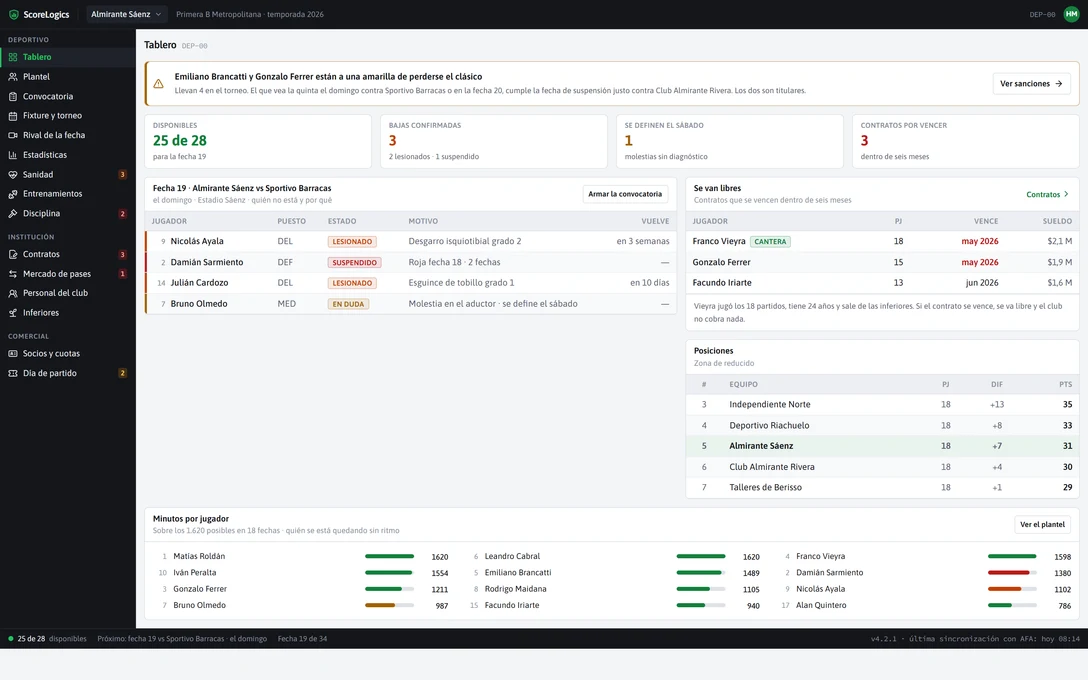
- The squad is sorted by availability and not by shirt number: the four who can't play at the top, the twenty-four who can below. The list answers before anyone asks
- Yellow cards are counted automatically and warn ahead: at four accumulated the cell says «1 to the ban», and the dashboard crosses that with the fixture list to say which match he misses. It's what keeps you from losing the holding midfielder right at the derby
- The team sheet won't let you include a suspended player —the mistake that loses matches off the pitch— but it does let you call up the one who's «a doubt», which isn't an absence: it's a player who tests on Saturday and travels anyway
- The match sheet is filled in once, the minute it happened, and the red card in minute 62 generates on its own the suspension that shows up in the squad two weeks later
- The medical report crosses the estimated return date against the fixture list: «three weeks» says nothing, «he misses round 19, round 20 and the derby in round 21» does. And recurrence is flagged, because it decides whether he plays ninety minutes again or comes on for twenty
- Contracts sorted by how long is left, with the six-month window shaded: it's the only stretch in which the club can still negotiate before the player leaves on a free
- The scouting report on the opponent doesn't list the last five matches —the coach already watched those—: it shows the pattern that only appears across eighteen rounds. Seven of nineteen goals from set pieces and five in the last fifteen minutes are two concrete jobs for Thursday, not a two-hour video
- Home and away points kept separate, always. The overall average is 1.72 and describes no real team: there's one that takes 2.44 at home and another that takes 1.00 away
- Open loans with the return date, the percentage of wages the club still pays and the buy option: a player worth $16M with a $9M option expiring in two months is lost to a date that went by, not to a bad negotiation
- Coaching staff, medical, kit and the youth setup in the same system as the players, with the «also» column that HR software doesn't have: at a lower-division club the kit man also drives the bus
- In the youth setup two columns instead of one: how many moved up and how many are still there. The distance between the two is the real metric of an academy
- The membership roll with the members and those paid up in the same table, because they're two different numbers and only one of them reaches the till
- And match day treated as what it is —an operation with twenty-three people, firefighters, police and a settlement— with the approved capacity, not the total capacity, as the number that rules