WarrantyShield: policies, renewals and claims for an insurance agency
A platform for insurance agencies in Florida: clients, policies, renewals, quoting, commissions and payments in one system, in Spanish and English on the same data.
- Client
- WarrantyShield
- Industry
- Insurance agencies
- Market
- United States
- Service
- Custom software
Where they started
The client is an insurance agency in Florida that serves both Spanish-speaking and English-speaking customers. Its team worked with a management system that did not cover day-to-day follow-up, plus loose tools around it. They wanted a platform of their own that would start with their agency and could later be offered to other agencies by subscription.
The day-to-day problem
Tracking expirations and installments depended on spreadsheets and on each producer's memory. A policy that lapsed was found out when the client called to report a claim, and by then there was nothing left to do. To quote, the same data had to be typed into each carrier's portal and compared by hand. And what each carrier pays per line was a separate calculation that nobody had at hand while serving a client.
What we built
- Clients: a profile with their policies, payments, quotes, communications and history, searchable by name, phone or policy number.
- Policies by line, with vehicle or property details where they apply.
- Renewals at 30, 60 and 90 days, with follow-up, new premium and the change from the old one, and renewal into the next term.
- Quoting that shows carriers side by side, with coverage next to price, to pick one and mark the quote as sent or declined.
- Billing: which installment is unpaid and whose.
- Claims on a stage board, from report to closing.
- Commissions: expected versus received, by carrier and by agent.
- Carriers with the commission on each contract.
- Payment and communication logs for every client.
- History: who changed what, with the before and after of each field.
- Team and roles: owner, agent and customer service, with email invitations.
- Platform console to manage agencies, users, subscriptions and security.
How it works
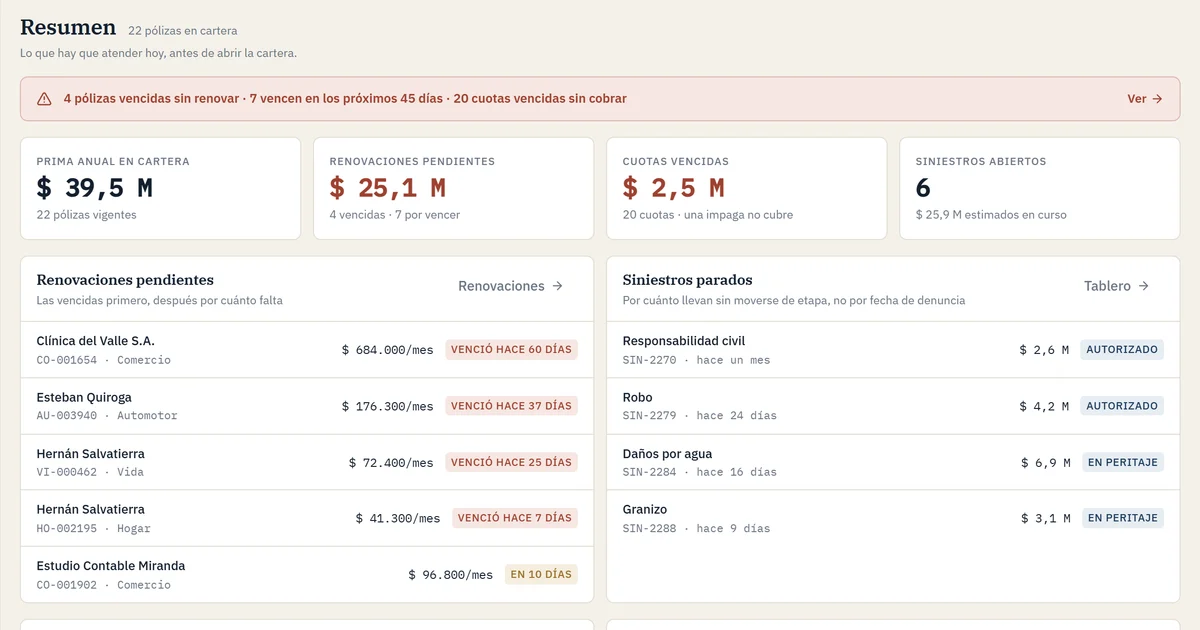
The home screen does not show the book of business but what needs attention today: what expires in the coming weeks, what is past due and the claims that have been sitting longest. The book says what exists; renewals and billing say who to call.
Each policy has its installment plan, with what is paid, what is pending and what is overdue, and the renewal queue is sorted by time left rather than by the date the policy was written. Claims move through stages, and what matters is how long each one has been stuck in its own, which a board shows without anyone doing the math.
Each person sees what fits their role. The owner sees the whole agency; the agent sees their own book and commissions; customer service works with clients and policies, without commissions.
Decisions we made
The first was to make the product multi-agency from day one. Everything hangs from an agency, every query filters by it, and data from another agency answers as if it did not exist; an automated test checks this. That lets the client's agency be the first and others join later without rebuilding anything. When the support team enters an account, it is logged and every change they make is flagged as made by support.
The second was to treat language as part of the product. In the same agency one person works in Spanish and another in English, on the same data. Statuses and internal keys are not translated: the screen looks up the text by key. Error messages and emails come out in each user's language. The English demo is also not a literal translation: it uses the trade vocabulary of the United States, such as agency, producer and lapsed.
The third was to deliberately separate what each role sees. Commissions by carrier belong to the owner: an agent who watches them starts choosing carriers by commission instead of coverage. Hiding a menu is not enough, so the server closes off the same things the screen hides.
Finally, access uses sign-up with an emailed code, temporary lockout after repeated failed attempts and request limits. An internal error never shows its detail to the user: it is stored with an identifier so it can be reviewed.
Where it is today
The base platform is built and deployed: accounts, agency, clients, policies, renewals, quoting, carriers, commissions, payments, communications, history and console. The agency is in the rollout stage. Still pending are loading the data from the system it uses today, document storage, subscription billing and the claims board.